

Skip to content

Buy Втягивающие in stock in Saint Petersburg.

No springs match the selected filters.

Why customers choose pull-type gas springs from VST

Quality control and certification

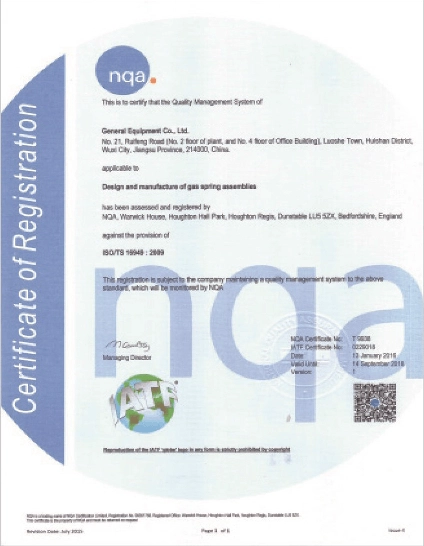
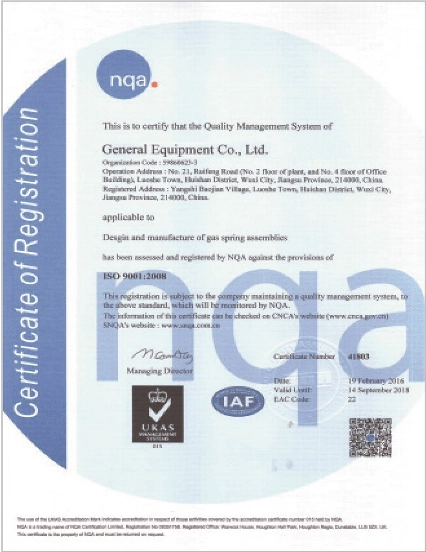
Certified to ISO 9001 and ISO/TS 16949 quality management — with continuous improvement focused on defect prevention and reducing variation and scrap across the supply chain.

Geometric parameter accuracyGeometric parameter accuracy
Corrosion testingCorrosion testing
Three-stage inspectionThree-stage inspection
Wear resistance controlWear resistance control
Low-temperature testingLow-temperature testing
High-temperature testingHigh-temperature testing

Geometric parameter accuracy

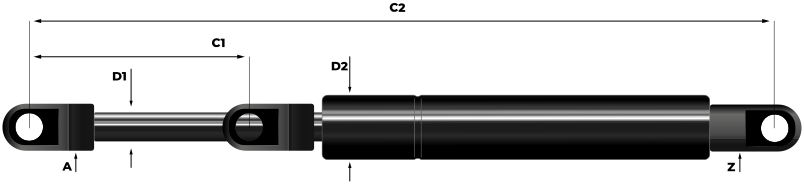
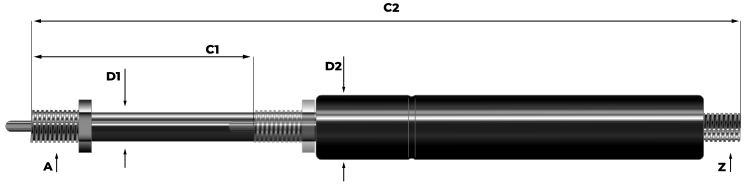
Rod Ø, cylinder Ø, stroke and length are controlled within batch tolerances so units fit mounts and mechanisms consistently.

Corrosion testing

Salt spray and humidity tests confirm rod and body coating resistance in aggressive environments.

Three-stage inspection

Incoming material control, in-process checks and final acceptance of every batch before shipment.

Wear resistance control

Cycle tests and seal checks reduce the risk of leaks and sticking during long-term use.

Low-temperature testing

Performance and force checks at sub-zero temperatures for outdoor and unheated applications.

High-temperature testing

Leak tightness and specs at elevated temperatures — for engine bays, industrial equipment and hot climates.
Production quality metrics

In-house defect rate
1 : > 1,000,000
Field defect rate
1 : > 998,000
Pre-shipment inspection
100%
On-time delivery
100%
Claims
< 1%
Customer satisfaction
> 99%
ISO 9001 certificate — TPK Vesta
ISO/TS 16949 certificate — TPK Vesta

Precision production and inspection algorithms

Every VST production step — from tube prep to end-fitting lubrication — follows a digital parameter profile. Automated test rigs verify force, rod stroke and leak tightness; deviations are logged per batch. That reduces spread between units and makes catalog-based replacement selection more predictable.

  1. Incoming inspection

    Raw materials

    • Geometry inspection
    • Corrosion testing

    Seals

    • Geometry inspection
    • Wear control
    • Temperature testing

    Components

    • Geometry inspection
    • Corrosion testing
  2. Full production cycle

    • Geometry inspection
  3. Control assembly

    • Geometry inspection
  4. Gas filling

    • Three-stage inspection
  5. Cleaning and coating

    • Geometry inspection
    • Three-stage inspection
  6. Warehousing

    • Three-stage inspection

Pull-type gas springs create extension force and return mechanisms to the rest position. Used for cable tension, panel return and pulling loads.

Pull-type gas struts

Force is directed to pull the rod inward — suitable when elements must be drawn toward the body. Selection uses rod diameter, tube diameter, stroke, length and force in newtons.

Applications

  • Return mechanisms for doors and flaps
  • Tensioners in special equipment
  • Removable panels and service covers
  • Industrial equipment with return stroke

How to choose

Verify force direction, stroke and rod/cylinder mounting points. Use catalog filters by diameter and force.

VST pull springs

TPK Vesta produces pull-type gas springs for OEM and aftermarket.

VST analogues for Stabilus, Suspa, Hahn and other brands

TPK Vesta manufactures VST gas springs — quality parametric analogues of original Stabilus, Suspa, Bansbach, Hahn and other brands. Examples from this category catalogue:

In Stabilus, springs in this group belong to the LIFT-O-MAT line (non-locking gas springs for opening, lifting and holding). TPK Vesta analogues use the VSTC series. LIFT-O-MAT.

See the full list in the catalogue above. Send your spring marking — our engineers will find the exact VST match.

Frequently asked questions

When is a pull spring needed?

When the mechanism must pull an element closed or provide return force in extension.

Same fittings as standard springs?

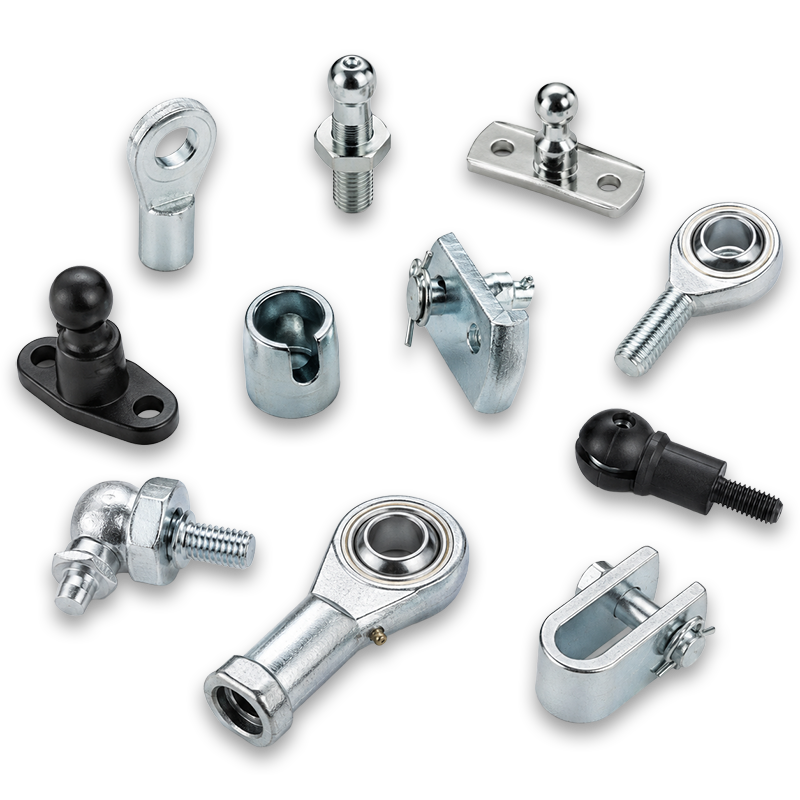
Yes — specify rod and cylinder fittings correctly when ordering.